When Is the Right Time to Start the IB PYP? What Parents Should Know?
Many parents exploring international education wonder: when should my child begin the International Baccalaureate Primary Years Programme? As holistic early childhood education evolves, IB PYP schools are gaining recognition for their inquiry-based, child-centred learning approach.
A common parent concern: Is it better to start PYP in preschool years or wait until primary school? Will my child be developmentally ready for inquiry-based learning at age three?
In this blog, we will clarify the ideal age to start the IB PYP, how the programme supports early childhood development, and what parents should consider when selecting IB PYP Schools.
What is the IB Primary Years Programme (PYP)?
The IB Primary Years Programme serves children aged 3 to 12, creating foundations that last a lifetime.
It emphasises holistic early childhood education through inquiry-based methods, global perspectives, and skills like communication, research, and thinking.
Rather than memorising information, children learn how to think- a crucial distinction for parents evaluating curricula.
Core Features of IB PYP Schools
What makes IB PYP Schools distinctive?
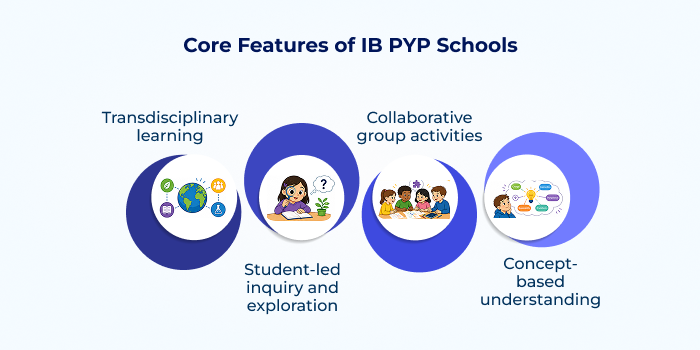
Students engage in:
- Transdisciplinary learning
- Student-led inquiry and exploration
- Collaborative group activities
- Concept-based understanding
This environment naturally supports the development of communication, research, and thinking skills.
Ideal Age to Start the IB PYP
The PYP typically begins at age 3 in the early years or preschool, and continues until age 12 (grade 5).
The programme spans three developmental stages: Early Years (3-6 years), focusing on play-based inquiry, Lower Primary (6-9 years), deepening conceptual understanding, and Upper Primary (9-12 years), developing independent research capabilities.
As childs are naturally curious at a young age, starting early in the PYP allows schools to nurture that curiosity rather than suppress it.
At this stage, children ask questions freely, explore their surroundings with interest, and learn through play & interaction. When introduced to inquiry-based learning early, they become more confident in expressing ideas and engaging with others.
What Skills Children Develop in Early PYP Years
1. Learning Through Inquiry
In the PYP early years, children explore concepts through questions and discussions that honour their wondering, hands-on activities engaging all senses, real-world connections making learning meaningful, and collaborative projects building teamwork.
2. Development of Core Skills
Through inquiry-based experiences, children develop critical thinking for primary students – analysing, questioning, and evaluating.
They cultivate creativity and imagination through open-ended exploration, problem-solving through real challenges, communication skills through presenting thinking, and self-management and independence through ownership of learning.
Signs Your Child Is Ready for IB PYP Schools
How do you know your child is ready?
Look for curiosity and interest in exploring new ideas, comfort interacting with peers in group settings, ability to ask questions and express thoughts, interest in hands-on activities and storytelling, and willingness to explore & experiment with new ideas.
The PYP is designed to build skills progressively, so children grow into the learning process.
Factors Parents Should Consider
- School Environment and Teaching Approach
When looking for an IB PYP school, observe whether teachers facilitate inquiry rather than direct all learning, classrooms centre on student questions and investigations, focus beyond academics to whole-child development, and educators possess proper IB training and methodology understanding.
- Long-Term Academic Pathway
Consider the complete IB continuum. Does the school offer the IB MYP and, potentially, the IB Diploma Program?
Seamless transitions between IB levels prove beneficial – students accustomed to inquiry approaches from early years thrive in later IB programmes.
Benefits of Starting the IB PYP at the Right Age
Starting the IB PYP at the recommended age of 3 to 6 years aligns with the period when a child’s brain is optimally programmed to benefit from play-based learning.
Key Benefits:
- Builds a strong foundation in critical thinking for primary students from an early age
- Encourages natural curiosity and a love for learning
- Develops confidence in asking questions and expressing ideas
- Strengthens communication and collaboration skills
- Supports emotional and social growth through interactive learning
- Helps children adapt easily to inquiry-based learning environments
- Fosters independence and self-management skills
- Creates a smooth pathway for future IB programmes like MYP and DP
Conclusion
Selecting the right age for the IB PYP programme is crucial. It allows children to grow naturally within an inquiry-based environment.
What matters most is choosing a school that understands how to balance structure with exploration and supports holistic early childhood education.
At The Shri Ram Academy (TSRA), Hyderabad, the IB PYP is designed to nurture curiosity, build confidence, and develop strong critical thinking for primary students from the earliest years.
Our early years classrooms buzz with purposeful activity.
When children begin their learning journey in the right environment, they don’t just learn better; they learn to love learning.
FAQs
1. At what age can children start the IB PYP in IB PYP schools?
Children can typically start the PYP at age 3 in an early years programme.
2. Is IB PYP suitable for preschool children?
Yes, the PYP early years framework is specifically designed for children aged 3-6, informed by extensive child development research.
3. Can a child join the PYP later if they did not start early?
Yes, a child can join at different stages, though early exposure may help with smoother adaptation.
4. What should parents look for when selecting IB PYP schools?
Focus on teaching approach, school environment, teacher training, and alignment with IB philosophy.

Ms. Aishwarya Kurra
Managing Director and Founder
Strongly believing in the innate potential that each child is innately blessed with, we partnered with Shri Educare in the year 2017 to bring Shri Legacy to Hyderabad. With the same passion and thought that the goal of education is not to increase the amount of knowledge but to create the possibilities for a child to invent and discover, and, Imbibe values as a way of life, we are now starting second school in Hyderabad, ‘The Shri Ram Academy (TSRA)’ offering leading international board curriculum.
Through proximity to nature, a diverse student population, and environmentally sound practices, The Shri Ram Academy shall reinforce and renew its deep commitment to producing Conscious Creators, Innovators, Leaders and Thinkers, who conform not to preconceived ideologies, but to the ever-changing needs of a dynamic future.
With the aim to make a difference in the growth path of the country, we want to bring in a ‘no-box theory’ where students’ learning is limitless, imitable and infinite in space and time of their choice.