Hyderabad has changed dramatically over the past two decades. Once known primarily as the city of Pearls, it is now one of India’s most dynamic metropolitan hubs, home to global technology companies, multinational corporations, and a rapidly growing community of internationally minded families.
And with the growth has come a surge in demand for something very specific: education that prepares children not just for Indian universities, but for the world.
That’s exactly why the best international schools in Hyderabad are drawing so much attention from parents today. But what actually makes them different, and is an international school the right choice for your child?
Not all schools labelled ‘international’ offer the same experience. What genuinely distinguishes the best IB curriculum schools in Hyderabad and other top international institutions is a combination of curriculum design, pedagogy, and learning culture.
Rather than prioritising rote learning and exam performance alone, international schools focus on developing skills that transfer across subjects and into real life – critical thinking, communication, collaboration, and independent enquiry.
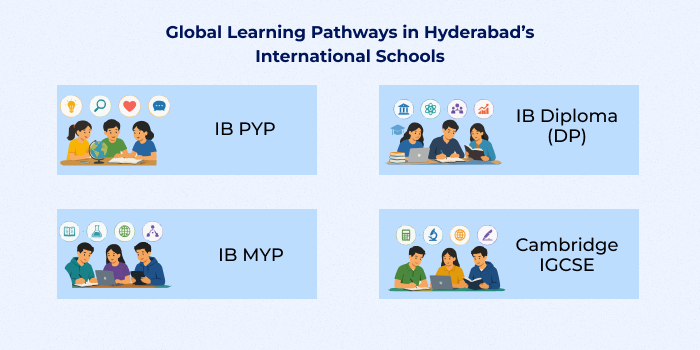
The most widely recognised global frameworks offered across Hyderabad’s top international schools include:
Curriculum | Age Group | Key Focus |
IB PYP | Ages 3-12 | Inquiry-based, transdisciplinary learning. |
IB MYP | Ages 11-16 | Conceptual learning, community projects. |
IB Diploma (DP) | Ages 16-19 | Academic rigour, global university preparation. |
Cambridge IGCSE | Ages 14-16 | Subject depth, international assessment. |
Hyderabad is uniquely positioned for international education to thrive. With over 1500 global companies calling it home, and with the mix of families from all over the world creates a truly cosmopolitan community – one that naturally values the kind of global perspective we teach every day.
This environment matters. Children who study alongside peers from different cultural backgrounds naturally develop the empathy, adaptability, and global awareness that modern workplaces demand.
Some International schools in Hyderabad see over 34% of their staff coming from international backgrounds across multiple countries, a reflection of how seriously leading institutions take the quality and diversity of their faculty.
International schools aren’t just about the buildings; they’re about the places that inspire. These campuses are the perfect places for students to experiment, play, and come up with new ideas because they have high-tech digital classrooms and labs, as well as cosy libraries and huge sports fields.
These are learning tools that support an experiential approach to education.
International schools don’t just teach content; they teach children how to learn. Project-based learning, real-world problem-solving, and student-led investigations are central to the daily experience.
This approach builds resilience, creativity, and independent thinking from the earliest years.
For families with ambitions of International higher education, this is significant. IB diploma graduates are accepted by universities in over 90 countries, and students at top international schools consistently earn places at top 100 universities worldwide.
The distinction goes beyond curriculum labels. It reflects a fundamentally different philosophy about what education is for.
Feature | International Schools | Traditional Schools |
Curriculum | IB, Cambridge | CBSE, ICSE |
Learning Approach | Inquiry-based, experiential | Structured, teacher-led |
Assessment | Projects, portfolios, coursework | Primarily exam-focused |
Global Exposure | High- diverse communities, global frameworks | Limited |
Skill Development | Strong emphasis on 21st-century skills | Moderate |
University Pathways | International and Domestic | Primarily domestic |
With several strong options available, here’s what to look for when evaluating schools:
1. Curriculum and Accreditation: Is the school an authorised IB world school or affiliated with Cambridge? Official accreditation matters enormously for recognition and quality assurance.
2. Faculty Qualifications: Look for teachers trained specifically in IB or Cambridge methodologies, not just subject specialists. The approach to teaching is as important as the content.
3. Infrastructure and Facilities: Visit the campus. The learning environment should reflect the school’s stated commitment to experiential and innovative education.
4. Community and Culture: Speak to current parents. The ethos of a school is lived in its corridors, not just written in its prospectus.
At The Shri Ram Academy, we offer the full IB continuum, from Early Years through to the Middle Years Programme, within a campus designed for curiosity, growth, and genuine global-mindedness.
If you’re exploring the top international schools in Hyderabad for your child, we’d love to be part of that conversation.
1. What makes international schools in Hyderabad different from CBSE or ICSE schools?
International schools follow globally recognised frameworks, like the IB or Cambridge, with a focus on inquiry-based learning, conceptual understanding, and holistic development.
2. Are IB schools in Hyderabad better for studying abroad?
Yes, the IB diploma is accepted in 90+ countries and highly valued by top universities because it builds exactly what they look for.
3. What is the average fee structure of international schools in Hyderabad?
Fees are very different from school to school, program to program, and facility to facility. The yearly fees at the best international schools in Hyderabad are usually between Rs. 3 lakhs and Rs. 12 lakhs or more.
4. How do I choose the best international school for my child?
Start with your child’s unique spark and your family’s future goals. Visit campuses, chat with parents, and see firsthand how the school supports individual growth beyond just the classroom.