Choosing the right curriculum has become one of the biggest decisions for parents today.
With growing awareness about global education pathways and changing career landscapes, many families are comparing IB Vs CBSE to understand which curriculum best suits their child.
Understanding the difference between IB and CBSE isn’t just about comparing syllabi; it’s about understanding which kind of learner your child is, where you want their education to take them, and what skills you want to carry through life.
This guide gives you a clear, honest picture of both.
What is the IB Curriculum?
The International Baccalaureate is a global framework known for its inquiry-based learning and student-centered approach. It’s built as a continuous journey that evolves as your child grows, split into three clear stages:
- Primary Years Programme (PYP): For students aged 3-12 years.
- Middle Years Programme (MYP): For students aged 11-16 years.
- Diploma Programme (DP): For students aged 16-19 years.
Rather than focusing only on academics, the IB encourages critical thinking, global awareness, creativity, and independent thinking.
Core Philosophy of IB Schools
The IB philosophy centers on developing inquiry, knowledgeable, and caring young people. Through intercultural understanding and respect, it aims to create a better, more peaceful world.
It focuses on:
- Inquiry-led and conceptual learning.
- Real-world application of knowledge
- Research, collaboration, and communication skills.
- Holistic child development
What is the CBSE Curriculum?
The Central Board of Secondary Education (CBSE) is a standardised, national-level educational framework. It provides a standardised, structured curriculum built around the NCERT textbooks, with a strong emphasis on Mathematics and Science.
Core Philosophy of CBSE Schools
CBSE emphasises:
- Structured classroom learning
- Textbook-oriented teaching
- Academic consistency across schools
- Exam-focused preparation
Difference Between IB and CBSE Schools
| Parameter | IB | CBSE |
| Learning Approach | Inquiry-based, student-led | Teacher-led, structured |
| Curriculum Style | Interdisciplinary and flexible | Subject-specific, syllabus-driven |
| Assessment | Projects, portfolios, presentations. | Board exams, periodic tests |
| Global Recognition | 150+ countries | Strong in India |
| Competitive Exam Prep | Requires additional coaching | Directly aligned |
| Focus | Holistic Development and Skills | Academic Knowledge and Exam Performance |
| School Availability | ~210 schools | 28k+ schools |
| Fee Range | Higher | More Affordable |
- Teaching Methodology
In a CBSE classroom, the teacher drives instruction and follows a predetermined syllabus, students build subject knowledge through textbooks and revision, and learning is assessed primarily through written examinations.
In an IB classroom, the students actively participate in learning, ask questions, investigate concepts across subject boundaries, and work collaboratively on real-world problems.
Neither approach is wrong; they are simply built for different outcomes.
- Curriculum Structure
CBSE focuses on subject-specific mastery, while IB takes an interdisciplinary approach.
CBSE emphasises a structured, exam-oriented design across subjects. It follows a fixed-stream system in senior secondary with limited interdisciplinary options.
IB is designed to foster global awareness and analytical writing. It is highly flexible, where students pick six subjects across distant groups. The assessment is a combined internal assessment, practicals, projects, and final written exams, offering a continuous evaluation model.
Benefits of IB Curriculum
The benefits of the IB curriculum become most visible in the long run. IB graduates consistently demonstrate stronger critical thinking, research ability, and self-management – qualities that stand out at university and in careers.
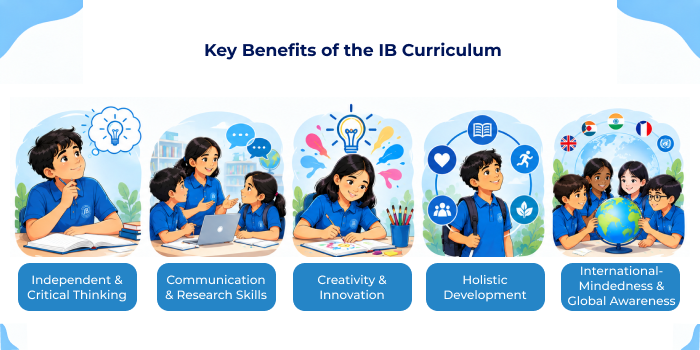
Some benefits include –
- Encourages independent and critical thinking
- Builds strong communication and research skills
- Promotes creativity and innovation
- Supports holistic child development
- Develops international-mindedness and global awareness
At schools like TSRA (The Shri Ram Academy), Hyderabad, the IB philosophy is implemented through inquiry-based learning, collaborative classrooms, and personalised attention that nurtures both academic and personal growth.
IB Vs CBSE: Which Curriculum is Better for Your Child?
Choose IB if –
- Your child is a “Why” kid who is naturally curious and loves diving into open-ended projects rather than just memorising facts.
- You’re looking abroad and focusing on international university pathways.
- You prioritise critical thinking, research, and emotional intelligence.
- Your child enjoys exploration and creative learning where there isn’t always one “right” answer.
Choose CBSE if –
- Your child performs best with a clear roadmap, a set syllabus, and a structured academic environment.
- You are focused on Indian Competitive entrance exams like JEE or NEET, which sync perfectly with this curriculum.
- You prefer a standardised, exam-oriented framework that is widely recognised across the country.
- You need wider school availability and a more accessible, affordable price point.
The most important step is to visit schools, observe classrooms, and speak honestly with admissions teams. A curriculum on paper is very different from a curriculum in practice.
FAQs
- What is the main difference between IB and CBSE?
IB focuses on inquiry-based and skill-oriented learning, while CBSE follows a structured and exam-focused academic approach.
- Which is better for higher education abroad: IB or CBSE?
IB is recognised for International university admissions due to its global curriculum and research-based approach alongside academics.
- Is IB more difficult than CBSE?
IB can feel more demanding because it emphasises research, presentations, and continuous assessment alongside academics.
- Which curriculum is better for competitive exams in India?
CBSE is often considered more aligned with Indian competitive exams such as JEE and NEET.
