Leadership is no longer seen as a skill needed only in adulthood. Today, parents want children to grow up with confidence, communication skills, emotional awareness, and the ability to work well with others.
But leadership doesn’t suddenly appear in teenage years. It develops slowly through everyday experiences, opportunities, and guidance.
This is one reason many parents are choosing IB PYP schools. The programme focuses not only on academics, but also on helping children become independent thinkers, responsible learners, and confident individuals from an early stage.
Understanding Leadership in the IB PYP Framework
The IB Primary Years Programme is designed for children aged 3 to 12, with a focus on developing the whole child academically, emotionally, and socially.
It focuses on holistic child development, inquiry-based learning, communication and collaboration, and social & emotional growth.
The IB Learner Profile sets out the qualities every PYP student is actively encouraged to develop:
| Learner Profile | What it Looks Like in Practice |
| Communicator | Sharing ideas clearly, listening actively, and debating respectfully. |
| Risk-Taker | Trying new approaches, speaking up, and embracing challenges. |
| Thinker | Asking questions, evaluating ideas, and solving problems independently |
| Caring | Showing empathy, supporting peers, and taking responsibility for others. |
| Reflective | Reviewing their own learning, understanding their strengths and areas to grow. |
How IB PYP Schools Develop Leadership Skills in Students
- Encouraging student voice and choice
In a PYP classroom, children are active participants – they are encouraged to share their opinions, ideas, and questions.
This helps to build communication confidence early, in an environment where every child’s voice is treated as worth hearing.
For young learners, this is significant. A child who learns that their ideas matter and learns how to express them clearly carries that confidence forward into every stage of life.
- Inquiry-Based Learning Builds Initiative
Leadership begins with initiative – the willingness to step forward, ask a question, and try to find an answer. The PYP’s inquiry-based approach puts this at the centre of everyday learning.
Rather than waiting to be told, students identify problems, explore possibilities, and take ownership of the process from start to finish.
This approach helps children become independent learners who take ownership of their thinking and learning process.
- Collaborative Learning Builds Team Skills
Leadership is about working well with others through group projects and shared activities.
PYP students work regularly in teams – on group projects, shared enquiries, and classroom responsibilities, developing exactly these skills in age-appropriate, low-pressure settings.
These experiences play a big role in student leadership development.
Key Features That Support Leadership in IB PYP Schools
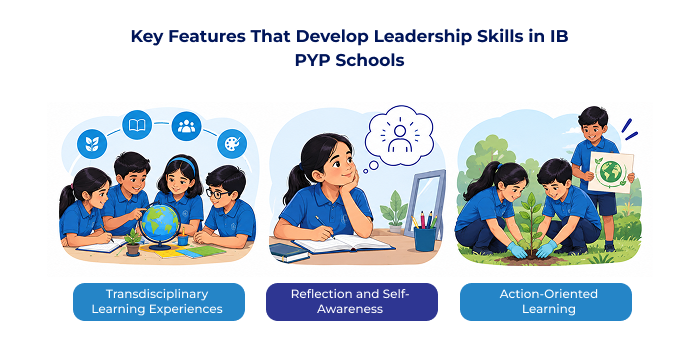
- Transdisciplinary Learning Experiences
IB PYP learning often connects different subjects through real-world themes. This helps children to think from different perspectives, understand real situations, and become adaptable problem-solvers.
- Reflection and Self-Awareness
Students regularly reflect on what they learned, how they worked, and what they can improve. This builds self-awareness and emotional intelligence, two qualities that research consistently links to effective leadership.
- Action-Oriented Learning
In PYP schools, action-oriented learning turns into knowledge into real-world impact by empowering students to apply classroom concepts meaningfully.
Through social initiatives and classroom responsibilities, learners take ownership of their environment. These experiences teach empathy, initiative, and responsibility from an early age.
IB PYP Vs Traditional Schooling: Leadership Development
| Aspect | IB PYP Schools | Traditional Schools |
| Classroom Role | Student-led, participatory | Teacher-led, instructional |
| Skill Focus | Leadership, collaboration, enquiry | Academic performance, memorisation |
| Decision Making | Built into daily learning | Limited opportunities |
| Self-Reflection | Regular and Structured | Rare or Informal |
| Real-World Application | Action-oriented projects | Primarily theoretical |
Conclusion
Leadership does not begin in adulthood—it starts in childhood through small everyday experiences.
By encouraging inquiry, collaboration, reflection, and responsibility, IB PYP schools help children build strong leadership qualities naturally over time.
At TSRA (The Shri Ram Academy), Hyderabad, this approach is reflected in classrooms where students are encouraged to ask questions, take initiative, and learn with confidence. Through a supportive and inquiry-led environment, children develop not only academic understanding, but also the communication, independence, and leadership skills needed for the future.
FAQs
- What leadership skills do children develop in IB PYP schools?
Children develop communication, teamwork, confidence, problem-solving, and decision-making skills.
- How does inquiry-based learning support leadership development?
Inquiry-based learning encourages children to ask questions, think independently, and take ownership of their learning.
- Are leadership activities part of everyday learning in IB PYP schools?
Yes, leadership is developed through discussions, group work, reflection, and classroom responsibilities.
- Why do parents prefer IB PYP schools for holistic development?
They support academic, emotional, social, and personal growth in a balanced way.
