It’s one of the most common questions parents ask when exploring school options: Is IB education actually worth it?
The question is fair.
IB schools typically come with higher fees, a demanding academic structure, and an approach to learning that feels quite different from traditional curricula.
But they also produce graduates who consistently secure places at top universities worldwide and develop skills that stay with them long after school ends.
So, is it the right choice for your child? Let’s look honestly at both sides.
The International Baccalaureate is a globally recognised education framework offered in over 5,700 schools across 160 countries. It’s built around the belief that learning should develop the whole person, not just academic knowledge, but character, curiosity, and the capacity to think independently.
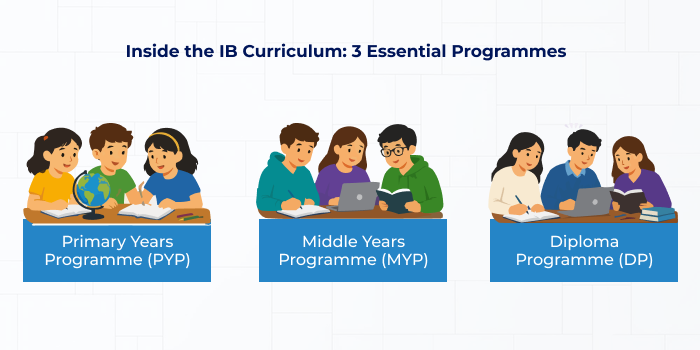
The IB offers three main programmes:
Programme | Age Group | Focus |
Primary Years Programme (PYP) | Ages 3-12 | Inquiry, transdisciplinary learning, and holistic growth. |
Middle Years Programme (MYP) | Ages 11-16 | Conceptual thinking, real-world connections. |
Diploma Programme (DP) | Ages 16-19 | Academic rigour, extended research, global university prep |
1. Globally Recognised and University-Preferred
The numbers back it up: IB graduates simply have an edge. In fact, studies show that IB students are up to 18% more likely to be accepted into Ivy League schools and 22% more likely to gain admission to top-ranked, non-Ivy universities.
Admissions officers recognise that IB students arrive prepared — with strong research skills, independent thinking, and genuine academic discipline.
2. Holistic Development, Not Just Academics
The IB curriculum advantages extend well beyond exam results. The Diploma programme’s core components – Theory of Knowledge (TOK), Extended Essay (EE), and Creativity, Activity, Science (CAS) ensure that students develop as thinkers, writers, and contributors to their communities.
Children in the IB system learn how to manage complex projects, collaborate across cultures, and reflect on their own learning.
3. Inquiry-Based Learning That Builds Curiosity
Rather than memorising information for texts, IB students learn by questioning, investigating, and connecting ideas across subjects. This inquiry-based approach builds deeper understanding and, importantly, a genuine love for learning that carries students through university and into their careers.
Being balanced matters here. IB education isn’t without its challenges, and it’s important to go in with clear expectations.
Aspect | IB | CBSE | ICSE |
Learning Style | Inquiry-based, conceptual. | Structured, exam-focused. | Detailed, language-strong. |
Assessment | Projects, essays, portfolios. | Board exams | Board exams |
Global Recognition | Very High | Moderate | Moderate |
Competitive Exam Preparation | Additional prep needed | Strong alignment | Moderate alignment |
Skill Development | Critical thinking, research | Discipline, content mastery | Language, analytical depth |
University Pathways | International and domestic | Primarily domestic | Primarily Domestic |
The real IB advantage kicks in after graduation. Students don’t just know more; they’ve learned how to think, manage complexity, and work independently.
This built-in global mindset and adaptability make them standouts at university and exactly the kind of people top global companies want to hire.
The IB is perfect for curious kids who love to explore and families eyeing global universities. It rewards creativity and independence over rote learning. It’s a big decision, so visit a campus, watch a class, and talk with your child about what truly excites them.
At The Shri Ram Academy, we believe every child deserves an education that genuinely fits them. If you’re curious about what the International Baccalaureate looks like in practice, we’d love to show you.
1. Is IB education better than CBSE or ICSE?
It’s all about finding the right fit for your child’s personality and their future goals.
2. Do IB students perform better in international universities?
Research consistently shows that IB graduates tend to outperform non-IB peers at the university level. They also enjoy higher acceptance rates at top universities.
3. Can IB students prepare for Indian entrance exams?
Yes, but it requires extra effort since IB focuses on deep research while Indian exams prioritise speed and specific content.
4. What are the biggest advantages of IB education?
The most significant advantages are its global university recognition, its focus on developing critical thinking and research skills, and its genuinely holistic approach to education.
Managing Director and Founder
Strongly believing in the innate potential that each child is innately blessed with, we partnered with Shri Educare in the year 2017 to bring Shri Legacy to Hyderabad. With the same passion and thought that the goal of education is not to increase the amount of knowledge but to create the possibilities for a child to invent and discover, and, Imbibe values as a way of life, we are now starting second school in Hyderabad, ‘The Shri Ram Academy (TSRA)’ offering leading international board curriculum.
Through proximity to nature, a diverse student population, and environmentally sound practices, The Shri Ram Academy shall reinforce and renew its deep commitment to producing Conscious Creators, Innovators, Leaders and Thinkers, who conform not to preconceived ideologies, but to the ever-changing needs of a dynamic future.
With the aim to make a difference in the growth path of the country, we want to bring in a ‘no-box theory’ where students’ learning is limitless, imitable and infinite in space and time of their choice.