Every parent wants the best for their children. And when it comes to early education, that decision carries real weight because the foundation you choose today shapes the learner your children become tomorrow.
With so many curriculum options available, it’s easy to feel overwhelmed. But more and more families are gravitating towards one particular choice: the IB Primary Years Programme (PYP).
Here’s why.
The IB Primary Years Programme is a globally recognised curriculum designed for children aged 3 to 12. It is designed to do more than just check boxes, but focuses on nurturing well-rounded, globally aware learners.
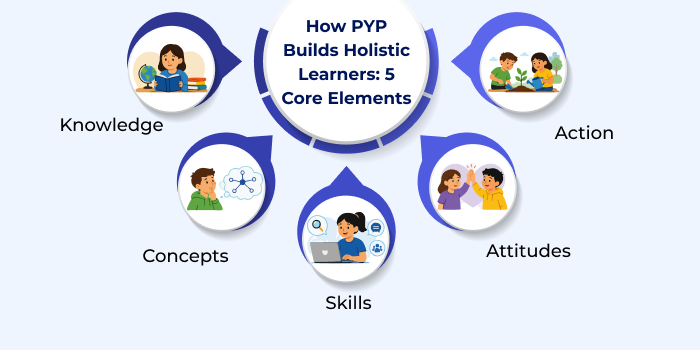
Rather than focusing only on content delivery, the PYP focuses on five core elements:
Core Elements | What It Means for Your Child |
Knowledge | Explore meaningful subject areas through real-world themes. |
Concepts | Understanding the why behind what they learn. |
Skills | Building research, communication and thinking abilities. |
Attitudes | Developing curiosity, empathy, and respect. |
Action | Applying learning beyond the classroom. |
In short, it helps children develop holistically, not only academically.
The IB PYP learning uses the inquiry-based learning approach, where children learn through asking questions, exploring ideas, and making genuine connections.
Instead of memorising facts or data, children are encouraged to ask questions that help to build deeper understanding and make learning genuinely meaningful.
Research shows that children in inquiry-based classrooms exhibit stronger critical thinking skills than those in traditional settings.
How is IB PYP different from the traditional curriculum? Here’s a simple breakdown:
Aspect | Traditional Curriculum | IB PYP Curriculum |
Teaching Style | Teacher-focused and textbook-driven. | Student-Centered and Inquiry-driven. |
Focus | Knowledge retention | Conceptual Understanding |
Assessment | Exams and Grades | Projects, Portfolios, and Observation. |
Skills Developed | Recall and Discipline | Curiosity, Creativity, and Collaboration. |
Learning Approach | Subject-by-subject | Transdisciplinary across subjects. |
1. Holistic Development
The PYP treats academic, social, emotional, and physical growth as equally important. Children are encouraged to express themselves, reflect, collaborate, and take responsibility, which helps them grow and serve long beyond school.
2. A Natural Fit to How Children Learn
Young children love to explore, and “why” is the most important word in their vocabulary. The IB PYP curriculum honours that instinct rather than suppressing it. Learning happens through hands-on projects, real-world investigations, and meaningful discussion.
3. A Smooth Pathway to Global Education
For families thinking long-term, th PYP offers seamless transition into the IB curriculum primary continuum moving into the middle years programme and eventually the Diploma Programme.
This continuity provides stability and a consistent educational philosophy throughout your children’s schooling.
4. No Heavy Exam Pressure in Early Years
Rather than relying on high-stakes tests, the PYP assesses children through observation, hands-on project work, and student-led exhibitions. We let children show what they’ve learned without the “exam jitters.”
Children who begin their educational journey through the IB PYP typically develop:
At The Shri Ram Academy, the IB PYP curriculum is a culture. One where every child is seen as a curious, capable learner with something meaningful to contribute.
If you’re considering the IB curriculum primary pathway for your child, we’d love to show you what learning looks like when it truly comes alive. Visit our campus today!
1. What is the IB PYP curriculum and how does it work?
The IB Primary swaps rote memorisation for genuine curiosity. Designed for ages 3 to 12, it focuses on five core elements that help students learn to question and explore, turning their natural “why” into a lifelong drive to understand and impact the world around them.
2. Is the IB PYP suitable for all types of learners?
Yes, it is designed to be inclusive and flexible to make sure it adapts to different learning styles and paces.
3. How does the IB PYP support a child’s overall development?
PYP develops social and emotional intelligence, critical thinking, and a sense of global responsibility. Children learn how to collaborate, reflect, and take meaningful action – skills that grow with them.
4. What are the long-term benefits of starting with IB PYP?
Children who begin with the PYP build strong conceptual foundations that support them through the IB MYP and DP.